Currently, all of our medical equipment deliveries are made on the most economical carbon-neutral basis wherever possible (depending on shipment volume and delivery requirements) by utilising the available cargo capacity in the underbelly of already scheduled passenger flights. Air freight remains essential for the urgent transportation of medical supplies due to its speed. However, sea freight is a more cost-effective option for less time-sensitive shipments, particularly where clients are able to plan ahead. It enables larger quantities of supplies to be transported in a single shipment, reducing transportation costs while having a significantly lower environmental impact than air freight.
By 2030, we pledge to work closely with our clients to plan and coordinate regular deliveries so that the majority of routine shipments can be transported via sea freight. This approach will not only reduce costs for our clients but also minimise the environmental impact of our supply chain.
What are scopes of carbon emissions?
Scope 1
Direct emissions from the combustion of fuel in assets that a company operates, such as fuel emissions from company-owned cars, diesel generators, gas boilers and air-conditioning leaks.
Scope 2
Indirect emissions from the generation of energy purchased from a utility provider, such as heating, cooling, steam, and electricity.
Scope 3
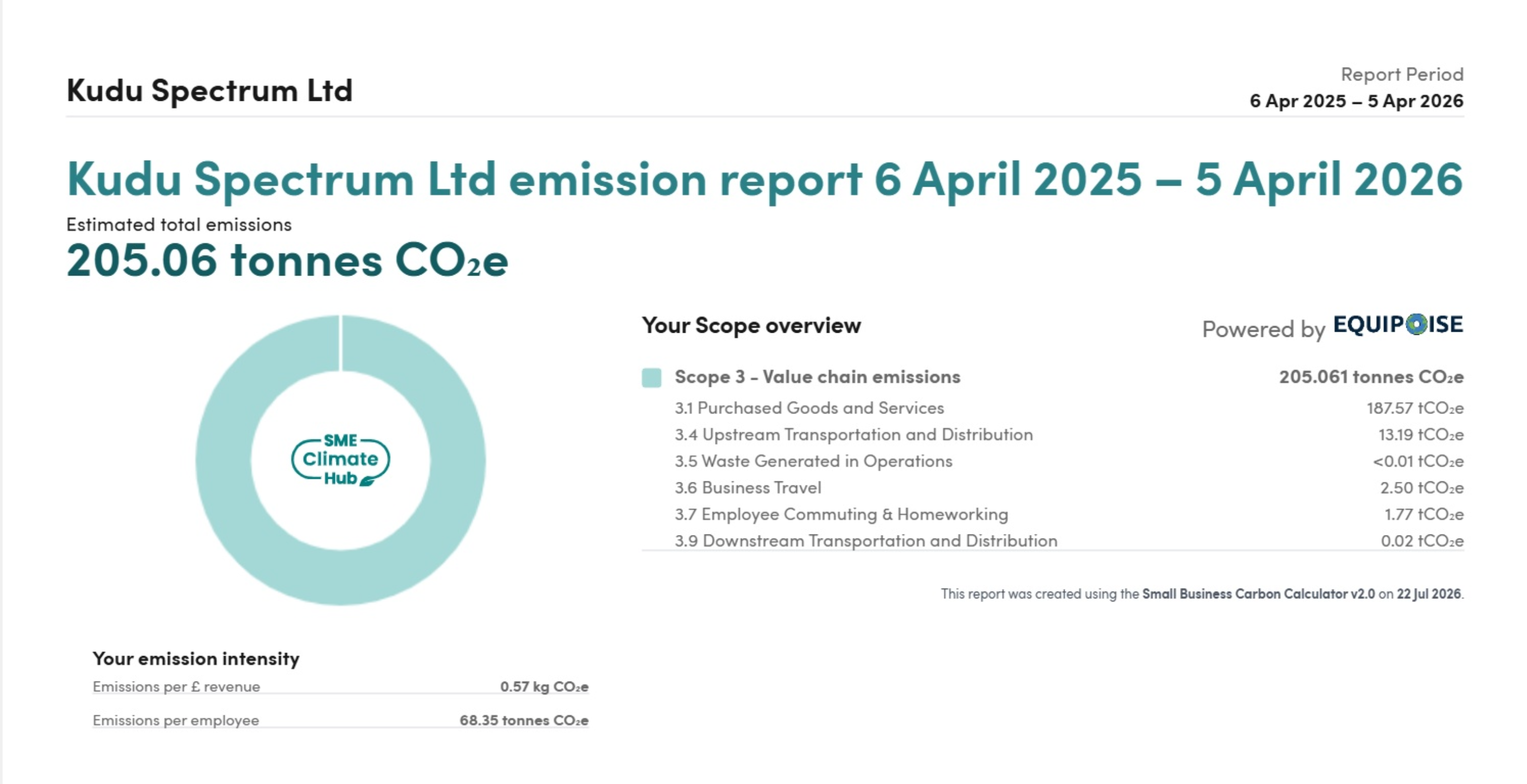
All indirect greenhouse gas emissions that do not fall under scope 2 – upstream and downstream. We have included upstream emissions from purchased goods and services, capital goods, upstream transport and distribution, and business travel, calculated from our expenses.
For the 2025/26 financial year, Kudu Spectrum recorded no Scope 1 or Scope 2 greenhouse gas emissions. In addition, through improvements in our operations and logistics, we have reduced our Scope 3 emissions by over 70% compared with our 2023 baseline. We remain committed to identifying further opportunities to reduce emissions across our value chain while continuing to deliver high-quality medical equipment and services.
As a company, Kudu Spectrum has operated on a fully remote basis since the pandemic, with no reduction in performance. This has eliminated emissions associated with employee commuting and significantly reduced the environmental impact of our day-to-day operations. We are committed to maintaining this flexible working model and will continue to prioritise online video conferencing wherever practical, travelling only when necessary.