Cancer Screening Programmes
Colorectal Cancer Screening
Option 1:
We can offer a combination of a FIT and Faecal Calprotectin Test, with one dry fluorescence analyser machine that both tests can be performed using. Experimental design analysed both FIT testing as well as faecal calprotectin and then determined the sensitivity, specificity and accuracy for each test and for the combination of tests. In total 658 patients were assessed – of which 286 were in the colorectal cancer arm and 372 in the adenomatous polyp arm.
| Detection indicator | Experimental Group (polyp / adenoma) | Experimental Group (colorectal cancer) | ||||
| Positive | Negative | Sensitivity | Positive | Negative | Sensitivity | |
| Faecal calprotectin | 314 | 58 | 84.4% | 236 | 52 | 81.9% |
| FIT | 252 | 120 | 67.7% | 336 | 52 | 86.6% |
| Combined | 342 | 30 | 91.9% | 262 | 24 | 91.6% |
Option 2:
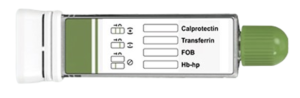
A Calprotectin/Transferrin/FOB/Hb-Hp combo test for the qualitative detection of Calprotectin, Transferrin, human haemoglobin and Haptoglobin-Haemoglobin in human faecal specimens. This test is CE certified and takes only 5 minutes to provide a test result.
| Test Name | Specimen | Time to result | Sensitivity | Specificity | Accuracy |
|---|---|---|---|---|---|
| Calprotectin / Transferrin / FOB / Hb-Hp Combo Test | Faeces | 5 mins | Calprotectin = 96% Transferrin = 99.1% FOB = 98.3% Hb-Hp = 97.9% | Calprotectin = 99% Transferrin = 98.5% FOB = 99.4% Hb-Hp = 98.6% | Calprotectin = 98% Transferrin = 98.8% FOB = 99% Hb-Hp = 98.4% |
Cervical Cancer Screening
We can offer a combination of the swab sampling device, storage tubes and the PCR mix solution (this detects all 14 high risk HPV infections) while separately identifying HPV 16 and 18 in the same mix and experimental design. Once carried out, the swabs are stable for five days at 4oC and for twelve months at -20oC (normal freezer temperature).
Prostate Cancer Screening
| Test Name | Kit Size | Specimen | Time to result | Sensitivity | Specificity | Accuracy |
|---|---|---|---|---|---|---|
| Prostate Specific Antigen (PSA) Rapid Test Cassette | 25 | Whole Blood / Serum / Plasma | 10 mins | 100% | 96.4% | 98.0% |
Liver Cancer Screening
Current liver screening programmes combine ultrasound and AFP measurement. Ultrasound is notoriously inaccurate in detecting small liver lesions in the fatty liver population.
Similar to the PSA screening an initiative could be set up to screen eligible citizens with a simple to perform point of care test which gives results within ten minutes. This will serve the purpose of selecting those individuals for further quantitative investigation.
The strategy would be to semi-quantitatively screen anyone with Cirrhosis or anyone who is either Hepatitis B or Hepatitis C positive. Those with an abnormal AFP level will be quantitatively tested using an immunofluorescence analyser. The same analyser can be used for both PSA and AFP screening. Eligible individuals should be invited back for repeat ultrasound and AFP test every six months.
| Test Name | Kit Size | Specimen | Time to result | Sensitivity | Specificity | Accuracy |
|---|---|---|---|---|---|---|
| Alpha-Fetoprotein Rapid Test | 25 | Whole Blood / Serum / Plasma | 10 mins | 99.1% | 98.9% | 98.9% |
Alternatively to AFP detection, Kudu can offer a multi analyte blood test combined with machine-learning technology in a groundbreaking algorithm for the detection of hepatocellular carcinoma – the most common form of liver cancer. The test is 20% more sensitive than ultrasound alone, and has a higher sensitivity and specificity than the combination of ultrasound + AFP. The test combines cfDNA methylation markers with patient demographic information and clinically available HCC tumor markers (components of the GALAD score) to enable robust and accurate HCC detection.
Breast Cancer Screening
Breast cancer is the leading cause of cancer deaths in women today. According to the World Health Organisation (WHO), one in every 12 women have the risk of a breast abnormality. Early diagnosis is very critical to decrease mortality rates.
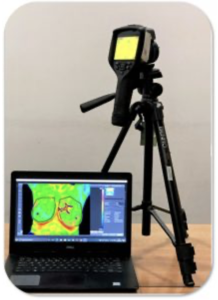
We offer a novel artificial intelligence-based medical device to detect breast cancer at a much earlier stage than traditional methods or self-examination. The high resolution thermal sensing device solution is a low cost, accurate, automated, portable cancer screening tool that can be operated in any clinic. The imaging method is radiation free, non-touch, not painful, and works for women of all ages. The core technology of the solution has been developed using a patented machine learning algorithm for reliable and accurate detection of breast cancer. This unique solution can be used as a cancer diagnosis test in hospitals, for regular preventive health checkups, and also for large scale screening in rural and semi-urban areas.
The thermal device is placed 3 feet in front of the patient and captures 5 thermal images of the region. The accompanying software automatically analyses these images and sends the analysis report to be certified by a Senior Radiologist. There is no minimum age for thermographic screening, it does not depend on the age, colour, race or density of breast.
| Test Name | Specimen | Sensitivity |
|---|---|---|
| Breast Cancer Screening [CE certified] | Thermal Breast Images | Results from clinical trials indicate very high accuracy that is non-inferior to X-Ray Mammography in general, and 25% better sensitivity than mammography in women with dense breasts. |